Showing posts with label Professionals. Show all posts

Tuesday, July 11, 2017

Organizational Development: How to continue your progression in the field

One of the questions or dilemmas from a class for Organizational Development was how would I continue to learn and apply knowledge of organizational development when the work we do is never transactional and the dynamics we experience in our organizations will challenge us to think differently and pointedly.

I posted this as an answer to this dilemma/question:

"I think that a great first step now that the class is wrapping up is to reread the textbooks at one’s leisure. Also, analyzing one’s organization or workplace, really looking at the benefits, the policies and procedures they have in place, then using what we learned here to ask where the organization can grow or do better for their employees.

There are also a bunch of Organization Development (OD) and OD related organizations that have free newsletters online or email lists that cover various topics which deal with LMS systems, Training and Development techniques to free downloads for presentations, which I have signed up for and assisted me in my school work or the workplace.  It is a matter of signing up for the right one is the challenge because some of these sites are just merely trying to sell you something.

Another way I am applying my knowledge of Organization Development is by writing a blog on subject matter that revolves around the field, then I am also connected through blogs and on social media with other professionals that discuss best practices and operational tips that consistently give them success in the field."

Hopefully, this may have some “tips” or make some light bulbs come on when you are thinking about what you are going to do as you leave graduate school and make your way out into the field. Possibly you can be a professional looking to extend your reach and brand hopefully this old posting can help. Are there any other tidbits that you can think of that may help other professionals or students learning about the field just near them in the comments section below.

Thursday, June 29, 2017

Organizational Clarity: upcoming topics

Looking through old assignments and found a couple of useful things that I can post upon here to help give some clarity to the field of organizational development. I noticed that many students and professionals post a few blog posts online with some great information but after a while either get disillusioned and quit or did it for an assignment then stopped after completion.

I started the blog as an assignment but decided to add more to it because there just is not a lot of information about the field out there. Plus, if there is any information it is usually disjointed or all over the place, giving the researcher multiple sources with bits and pieces everywhere. Hopefully, these new posts will streamline that process for everyone and make researching for material and sources easier for everyone.

Thursday, May 4, 2017

Organizational Clarity: “How to Deal With a Boss Who Judges You By the Company You Keep” article

Although I usually do not prescribe to some of the issues brought up in this article some of these arguments are valid. It is very often that upper management does lump employees in together, the whole “guilty by association” assessment is done far often than we care to admit (Boinott, 2017). This article does have some good points in keeping it professional at work and keeping co-workers at a distance, mainly because some of them you need to. There are many individuals who you can trust, and there are others you simply just cannot.
Then adding alcohol to the mix can redefine a situation in the worse way, things that are usually kept to oneself just slips out into the open and probably shared with others who will simply, in turn, share with upper management. I have dealt with co-workers who were usually the “devil’s advocate” for upper management and other misshapen factors that made the workplace unbearable and although I gave them a chance to connect I simply knew after a while to drop them as “good” friends. Meaning I kept everything with these individuals professional and usually let them get burnt by their own devices, in the same professional settings, while dodging them or leaving them out of personal events. 
Keeping away from certain individuals because of fears that you may be lumped into a wave of retribution from upper management, is maybe one great reason to stay professional at work. However, realize that these same individuals may do irreparable damage even outside of the workplace, becoming distractions to us from developing ourselves professionally and personally. In the end, as the article states it is best to know who these “distractions” are and maintain the proper relationship (whatever that may be) with them, i.e., one with distinct boundaries.
Boitnott, John (2017) “How to Deal With a Boss Who Judges You By the Company You Keep” February 21, 2017, Entrepreneur Media, Inc Retrieved from  https://www.entrepreneur.com/article/289367

Tuesday, April 25, 2017

Organizational Clarity: “Reason this woman’s job interview was canceled” article part 1

Although I never heard of this; I recently read an article that explained a job candidate had her job interview canceled because she asked about salary and benefits! The company is one that customers can order food and take out online from restaurants in small markets, similar to the services, Peapod and Grubhub mixed. It is understandable to ask this questions before undertaking a job opportunity especially if this information was not covered either in the job listing (description) or the first interview that this candidate had with the interviewer (representative) for this organization. 
Before I take any job or even apply for jobs online through Indeed or Careerbuilder I would look for the salary or benefits linked to the job, most job listings that do not have this information listed usually infer that the applicant should ask about these items during the interview. If the job listing does not have any of this information, I have a golden rule: Do not apply, simple as that. Why go through what this applicant went through?
In fact, in response to this applicant’s question, the organization replied that it is not part of their organizational culture to have applicants ask these type of questions. If this is against the organizational culture, then applicants must ask what else is? Does the organization have a mission statement or handbook in which this is written or is this an “unspoken rule” that is just implied and thereby opens the doors to more adjustments to what can be considered an employable rule? Because of these types of issues is the reason why laws and other protections were made to ensure that these type vague employment statutes do not occur or repeat in the workplace.
The fact that this organization does understand that this loose structure of rules and organizational culture in regards to what determines corrective action or even a breach of employment agreements simply makes it worse for all the organizations that share its market space. With most organizations worrying about more rules and regulations coming down upon them from Federal, state or local governments that the last thing needed is an event like this with such “hoopla” and attention that restricts them even further.
Just click on the link here to learn more: https://www.yahoo.com/news/reason-woman-job-interview-canceled-215408983.html

Tuesday, March 14, 2017

Organization Clarity: when you choose your career path

When it comes to selecting your career path it, as this article states, is based off of us, as individuals comparing ourselves against the success of others (Sonenshein, 2017). Also, cultural influences play a part of the individual, as the article states, chasing goals that are not their own. We look at others in our peer groups or even outside as standards of success when we should actually look and identify with what we are comfortable with.
Most of the time psychologically we are not equipped to do the things that the individuals we consider a success have done in the process of being a success. Sometimes we are not even emotionally able to handle the amount of rejections, losses or even critique that come with these career paths. Some people can handle the 24/7/365 high-speed corporate world and looking from the outside this may seem like a standard of success due to the money made and respect garnered, however the daily grind to making this possible is not acceptable or possible.
Either due to the lack of emotional intelligence or even a lack of professional skills as you see I mention multiple variables that constantly rear its ugly head to determine if an individual is able to handle a particular career path. You may want to be the next president of the United States, when if you take into account all of your psychological needs, and capabilities you may be happier being as a blogger! 
In essence, when you choose your career path just take a really good look at yourself, not someone else, to determine if you are putting all your time and energies into the right field. Culture, friends, and family may tell you one thing but in the end, they are not paying your bills, dealing with the struggles in your professional life, nor are they the ones who live with this decision every moment of every day. Reflecting upon yourself will allow you to be happier in your occupation but also you will save yourself time, money and a whole lot of stress!
Sonenshein, Scott (2017) Why Do People Chase the Wrong Career Paths? February 15, 2017 TheHuffingtonPost.com, Inc http://www.huffingtonpost.com/quora/why-do-people-chase-the-w_b_14749038.html

Tuesday, February 28, 2017

Organizational Clarity: "How is your Culture Quotient?" article

This article by Marcella Bremer talks about the culture Quotient of an organization discussing the sensitive issue of diversity in the workplace. Emphasizing the need for Cultural competency that allows professionals to navigate the workplace environment with their co-workers without making waves or causing major HR issues. This way everyone involved can increase their awareness of other cultures, build morale and create a creative, collaborative environment.
If you want more information this brief article summarizes the point and need of a Culture Quotient in every organization just click on the link:
https://www.ocai-online.com/blog/How-is-your-Culture-Quotient?awt_l=lzhjiA&awt_m=3bCXosEPbWsRmh3

Sunday, December 18, 2016

Employees going Berserk at a Holiday Party: something for the Organizational Development Professional to consider.

I read an article regarding a fight at a company Christmas party at a high-end restaurant in New York, it is interesting how this sometimes occurs in during these events. As an Organizational Development (OD) professional one must think of such occurrences or keep them in the back of your head as you plan morale building or holiday events.
Usually, issues like this happen when alcohol is involved so having a boring, non-alcoholic party may not be on the top of anyone’s list as fun, but it saves the organization from bad press such as this. As an organization one cannot condone violence in the workplace or outside of it at company functions, therefore limiting alcohol, unfortunately. must be a possibility that the OD specialist must recommend to their clients.
At least it gets the professional in the clear of any blowback if a client rejects such a suggestion and this type of event occurs at the event the OD professional has created. What are your thoughts?
Here is the hyperlink to the article from the New York Post I mentioned above:


Saturday, December 17, 2016

The Organizational Development YouTube playlist.

So to streamline the resources I have found on YouTube regarding Organizational Development and I made a YouTube channel of the same name “organizational development” for now I have only 10 videos here is the hyperlink for the playlist:
The playlist covers these videos:
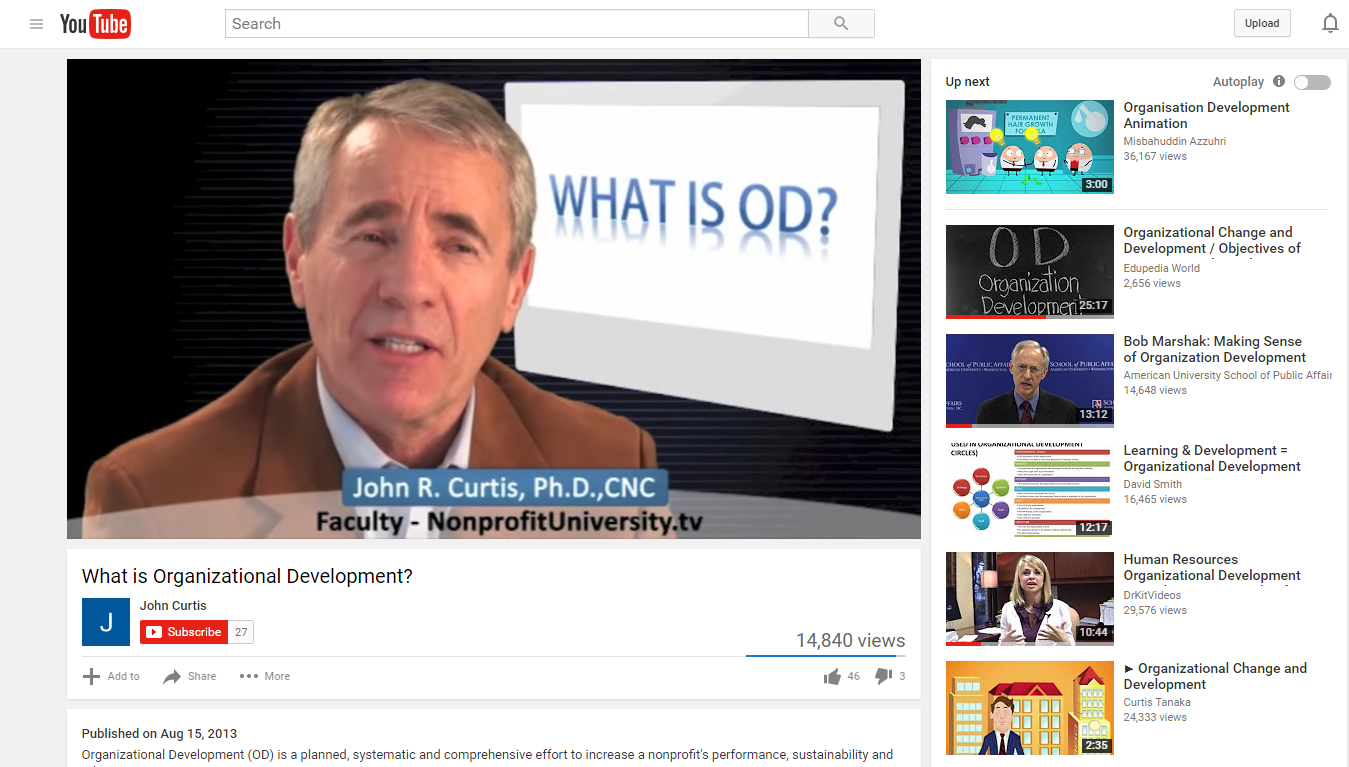
  1. What is Organizational Development? by John Curtis
  2. Organizational Change and Development / Objectives of Organizational Development by Edupedia World
  3. What is Organizational Culture? by Denison Consulting
  4. Human Resources Organizational Development Consultant, Career Video from drkit.org by DrKitVideos
  5. Bob Marshak: Making Sense of Organization Development by American University School of Public Affairs
  6. Resistance to Change - based on Harvard article by Esteban Elsa
  7. What is organizational CHANGE? by Mavim
  8. Lesson 10 Organizational Culture and Change by Teo Hiro
  9. Strategies for Organizational Change by Theleaderdoctor
  10. How to Deal with Resistance to Change | Heather Stagl | TEDxGeorgiaStateU by TEDx Talks
You will, of course, find video descriptions after you click on the video hyperlink, but rest assured these are all videos that are Organizational Change and Organizational Development related I tried not to pick video presentations that were too “dry” and that were fun so it can be more engaging. Happy viewing!  


Creating the YouTube channel from an Organizational Development standpoint.

For a class in my graduate studies, I was introduced to creating a video or tutorial online, so I picked something for this assignment that everyone could use when starting out with their own individual google account.
As Organizational Development (OD) Professionals you may need to create, produce and distribute video presentations regarding OD or for whatever your organization needs, this generic tutorial will help you take an existing google account and create a YouTube playlist of all your videos. Videos for your personal use to watch over and over again, or for (again) your Organization usage, creating and posting videos on YouTube or even linking videos posted by others for official repeat usage.
Here is my video called “YouTube playlist with existing google account”:
This is the step by step script I used for the video it may help with creating the YouTube channel:
  • Today we are going to create a YouTube playlist with an existing Google/Gmail account, for this to work you will, of course, need an existing Gmail account. For this process, I will be using google chrome as the primary web browser.
  • Since google chrome is my browser of choice it gives me the Gmail button at the start up screen to start the sign in process. However, if Google chrome is not your web browser of choice, you can do what I am doing here and type in Gmail.com into the address bar and it will get you to the same sign in screen, either way, is fine.
  • Since my Gmail account is difficult to spell I am going to cut and paste it in the “enter your email” box and hit the “next” button, will get you to the password screen.
  • This will get you to the password screen where you can see my Gmail profile picture, name and email address above the password box. So I will just type in my password and hit the “sign in” button.
  • This brings me back to the Control-Protect page don’t worry just go to the right-hand corner on the page where there is a series of boxes and click on it.
  • There you will automatically see a bunch of applications plus an option for YouTube click on to that button.
  • This will take you to youtube.com
  • Now think of a few videos you want to add to a playlist and type the subject into the search box up above.
  • For this, I want to start with something in Organizational Development as you see it will automatically come up so I type that into the search box.
  • Now as you scroll down the search you see a number of videos, for this, I will just choose one, John Curtis’ video will be fine, so click on the hyperlink for it.
  • Usually, I turn down the volume, so it does not disrupt the process.
  • Now I move my cursor under the title of the video to a plus icon on the left that has “add to” next to it and I click it.
  • An Add to box, will come up with an option for “create new playlist” for this Gmail account. I simply hit the “create new playlist” button then I will name it: “Organizational Development” now I have an established channel so if I want to add additional videos at a later time to it I can.
  • For now, I have completed creating a YouTube account for this Google/Gmail account. With a playlist, you can watch a collection of videos over and over again without continually searching YouTube for the ones you prefer to see multiple times.
  • All you have to do now when logged into your existing Gmail account is type in youtube.com as you see here, now you will go to the left and there is a library section where your playlist will be listed. Click on to the playlist you want the screen to the left will reflect the playlist selection on the next screen. To start it, all you have to do is go up to the “Play all” button to start the playlist anytime you want.
  • And with that, this concludes how you create a YouTube playlist with an existing Google/Gmail account using Google chrome as your default browser. Thank you.

Friday, December 16, 2016

Do Reunions have a connection to employees quitting?

As an Organization Development professional, we must take all possible factors into account when dealing with the various causes of an organization’s turnover rate. Whether that turnover rate has increased or decreased we must take all factors or reasons into account to either replicate those factors if the turnover rate has decreased or eliminate those factors if there is an increase in employee turnover.
In a recent article, “This Is When You’ll Quit Your Job” it is mentioned that people will “quit” their job after attended a reunion or other such milestones in a person’s life. Now I have heard of someone reaching 50 or 60 and questioning their career choices, and possibly quitting their job to move into their “dream” career that they have wanted to try out for years. Even with that reason the actual attempt or percentage of such attempts do to this reason is so low it is really a non-factor. Furthermore, I have never heard of a high or college reunion having the same effect upon a person deciding to change careers.
To isolate this as a factor alone I did the poor man’s research method and googled it and poof ….nothing! Nor have I heard this as one of the many employment urban legends, meaning it is not a story that I have ever heard before unlike the employee hitting an age milestone and moving into a new career. Now that I do not have to research at all, I have about three family and friends who are stating they are moving to an entirely new career at a certain age.
My point regarding this article as an Organization Development professional are these factors that we should take seriously when calculating an employee’s risk of turnover? Or would taking in factors of one’s age or the time of their high school reunion simply discrimination? If a determination of one’s high school reunion becomes a factor in a formula to determine an employee’s turnover chances, highly unlikely, but IF it does, how does NOT attending the reunion factor into that percentage?
Tracking the chance as the article states your willingness to change careers after you have been with an organization for a certain amount of time, is possible and totally legal, but tracking employees or collecting data for such career changes due to age or one’s high school reunion (which could be tied to age) could be damaging for the organization or the employee, As I aforementioned this could mean legal consequences for the organization if they use this factor in determining future turnover rates, what other issues you think may arise from using this type of outliers as data for turnover predictions? Personally, from an OD standpoint, I think clearly this should be left alone.
Money.com (2016) “This Is When You’ll Quit Your Job” http://finance.yahoo.com/news/ll­quit­job­120017492.htm

Thursday, December 15, 2016

Interviews: a tedious process

Interviews, of course, we have all went on at least one or two in our lifetimes, but a question I wonder about is: How many interviews do you go on before you change the way you do things?
I remember one time I applied for an Account specialist position with American Express a few years ago, strangely I went on not one, not two, but three interviews with the same interviewee! Now I have been through a phone interview, then face to face interview with an HR representative, then an interview with a hiring manager. But this was one of the most frustrating strings of happenings among many of the times I was looking for employment. 
So near the end of the third interview when the interviewee made it known there would be a fourth interview, and at he looked forward to talking with me again, he wanted to ask one final question. That question was “What is your pet peeve?” I told him that, “…going on too many interviews because they are very stressful...” of course, after that day I did not hear from him about the position again. What I did there was made my intentions known that I could not go to a fourth interview, there were other opportunities that were offered at the same time and I had a lot of difficulty scheduling other interviews around the AMEX interviews.
Making your intentions known during interviews is not something that you should shy away from, that way you can see if it is the right opportunity for you. This was something I learned to do since then because it freed up my schedule for looking into other opportunities including those which lead me to pursuing my education in Organization Development. Changing the way I approached interviews has evolved since then, I have created a set of standardized questions to ask during interviews, I have made sure that if there is a second interview I had another suit ready to go and that was of articles of clothing that was totally different than before. I have been able to “see” now if the positions I have applied for are right for me with more clarity than ever before, just by changing up the way I approached the interview process.
From an Organization Development standpoint, a candidate who comes in asks questions about the organization, the position, and states what they are looking for right off the bat is a godsend. It means that the candidate is serious about the process, serious about their interest in the positions and makes filling that position with the right candidate so much easier. Every Hr representative or hiring manager should be looking for someone like that, why would you hire someone that is counterintuitive to that?


Is experience or a degree a factor in the hiring process?

How much of a factor is experience when filling a position and does a degree outweigh years of spent by a seasoned professional? In Organization Development (OD) we learn the strengths and/or weaknesses of an organization’s employees through testing and training but in the hiring process determining the true nature of a potential employee’s strengths and weaknesses is a challenge.
Of course, you say that is why we have the applicants give resumes to present an overview of what they can do. Resumes are subjective pictures or interpretations of the applicant’s personal view of their professional career. Meaning that wading through, reading and understanding what each individual is trying to state when they are discussing their job descriptions at past positions is akin to the old telephone game with the two cans on a string.
The majority of the time the message does not get through, hence when a candidate applies with a freshly earned degree there is a desire to rush to hire to limit the issues and time period connected to the hiring process. Although as we now know, this is not always a good thing and recent college graduates are not always the best candidates for the positions we are trying to fill.
This is where experience comes in, candidates with extensive experience in similar fields or in the general  workforce may be a better fit, individuals that have had years of experience are more likely to adjust and adapt to difficult situations that occur in an organization. Compared to recent grads that have the impression given to them from academic presentations of how the workplace is supposed to operate. Coming from another job in comparison to coming straight from an academic setting can mean a world of difference in terms of qualitative characteristics required for a position. Levels of maturity and stability that can translate into a lower turnover rate for an organization are hard to measure but are also something that you cannot get from a degree.
Since the early 2000's there has been a new requirement for college graduates by organizations in today’s workforce with the unwritten belief that with a degree, will come new ideas of communication and innovation for an organization. Where the problem lies, is that with an organization there is a needed to conform to a hierarchy structure that is not learned in academia and that structure is favored over collaboration. This understanding comes with experience as many organizations are learning now, and are leaning to candidates with a degree AND experience, however, with this increased requirement the hiring pool becomes slim or shallow.
With increased focus upon experience over degrees, one hopes that this does eliminate individuals applying with no experience only a leveling of the playing field when it comes to the hiring process. Professionals versed in Organization Development can assist organizations when it comes to hiring the right individuals for specific positions that require certain skill sets and personality traits. When it comes to the hiring process having an OD professional on staff can make the difference between a lengthy hiring process and high turnover for an organization in comparison to the ideal situation in which it all flows together.

Wednesday, December 14, 2016

The New Overtime rules from an Organizational perspective

The new rules for overtime became law on Dec. 1, 2016, this means employees that work over the 40-hour work week will be required to be paid time and a half (Gibbons, 2016). From an Organization Development standpoint, it is a challenge, on the one hand, there are negatives and positives for the employee and then, on the other hand, the organization.
With this type of new rules as the article states, organizations will now need to be mindful of how they allocate their resources when it comes to scheduling their workers. This may as the article stated on the organization side will lead to slashing hours, elimination of management staff and reallocation of task assignments (Gibbons, 2016). These maybe all negatives, however, this means that organizations will be required to write accurate job descriptions instead of promoting general descriptions. Meaning instead of having “administrative duties” listed in a job description during the hiring process the position must be specific in all task assignments (Gibbons, 2016). No longer will project managers have to worry about generalities in what a staff can do or cannot do, this translates to employees across the board being trained in the same tasks. The requirement will streamline training programs to focus
Meaning instead of having “administrative duties” listed in a job description during the hiring process the position must be specific in all task assignments (Gibbons, 2016). No longer will project managers have to worry about generalities in what a staff can do or cannot do, this translates to employees across the board being trained in the same tasks. The requirement will streamline training programs to focus on certain skill sets rather than individualizing the training increasing costs and draining other resources.
For the employees although there is a bump in pay and the unspoken requirement of working off the clock is eliminated by this new rule, as these are all positives, employees actually getting paid for all the work they do for an organization (Gibbons, 2016). The negatives are that some organizations will cut hours for employees to make sure that they do not have to pay the time and a half in overtime hours, this also may mean more automation for certain tasks to streamline, in turn, the workforce. This could also force organizations to translate more employees hourly to salary in order to bypass this law altogether, which sounds great but the amount of time spent working for a salary employee can be more than if they were hourly (Gibbons, 2016). Plus, over time the ratio of dividing in the hours worked into the salary given by the organization may equal or be less than the take-home pay of the hourly employee now making time and a half for over time.
Now in the realm Organization Development we would have to determine which of these negatives would be positives for the organization first and then the employees, and how to deter or overcome any waves of turnovers created by exiting employees who go elsewhere as a result of the organization’s decision. Eliminating employee hours to a fixed, expected rate of 40 hours and under, along with accurate job description allows a project manager to create a more accurate “pitch” for the projects, procedures or products they wish to be approved for implementation. This will assist the project manager to request, plan and adjust a budget in which can have less overhead and also lessen the probability of outliers that can disrupt the project when it comes to the aspects of scheduling and payroll.
So, in either case, the new rules can be a headache for organizations it may be a chance for an Organization Development specialist to prove their worth and show the importance of investing in Organization Development as a science, a way of thinking, and an attitude to approaching an organization’s problems.  The trick for the specialist will be to find the silver lining in such rules and make gold from it.
Are there any other issues you see my become an issue for the Organization Development specialist that is not mentioned in the article or in this blog entry? Do you think as a result of these new rules will increase automation in organizations and higher rate of eliminations of an organization lower management staff? Do you think that these rules harm the employee more or the organization more? Do you think that these rules hurt the employee more or the organization more?
Gibbons, Lauren  (2016) “New federal overtime regulations could have big impact on Michigan businesses, employees” July 04, 2016 MLive http://www.mlive.com/news/index.ssf/2016/07/new_federal_overtime_regulatio.html

Post a Detailed job description.. Please

One of the many problems with employee recruitment presently lies with the description of the position that the organization is in dire need to be filled. Usually, the author has an idea of what the position entails, however, it is usually the case that the what is not listed in the description is conveniently listed as “other duties” or “additional duties may be added”. This is a commonplace practice that occurs the majority of the time, however, that does not make it right, efficient nor does it make it a productive usage of time or effort.
The less details added to a posting on a job site whether it is the organization’s own employment site, external business site or even when the organization uses an employment agency, a specific detailed job description of the position is required. This is because descriptions can be misinterpreted by the either the interviewer, the agency representative and even the person applying for the position.   
In a world where there is an increasing emphasis on getting the job right the first time, being efficient as possible and getting the candidate for the job on the first attempt, incorrectly written job descriptions counteract the aforementioned desires of organizations that are trying to watch their bottom line.
When I look at a job description that has less than a paragraph and has those famous words: “and other duties” I know that the author cares as little about the process, or about getting the right candidate for the job. To the author, this is their job and if it is done incorrectly, or done very well, it does not matter to them at the end of the day, it is just their “job” and possibly the individual that the organization does not want interviewing future candidates nor writing job listings in the near future.
Which then falls upon the organization for not getting the person to do this task/job as well, basically becoming its own vicious circle which wastes the time of everyone involved. Time, a precious commodity if you are in a hurry to fill the position because it is either a very crucial position to an organizational department “time is money” as the old saying goes.
Or it could be that the tasks needed to be completed by the person in this position are now being divided up amongst different members of the department which now is driving down the productivity of the entire department. This extra work that other members in the department has to do to cover for this missing individual is in turn, overtasking and taking its toll upon its members.
Leading to overuse of sick days, higher turnover rates, etc., just because one poorly written job description is holding back the hiring process. I have seen this many times before and have been one of those people in the department overworked because of it, and it is not a pretty situation. And usually members of the overworked department are then on external job search sites looking for a new job, sounds familiar?
Which gets me back to the original point that if a job description is done right, detailed enough an organization can get the right applicants for the jobs so that this ripple effect does not occur. If an organization wants the best, then take the time to write what you are expecting from the best, it does not have to be Hemingway, just something that does not waste the time of everyone involved. Plain and simple.

Tuesday, December 13, 2016

The use of high end vocabulary in job listings is it really necessary?

Recently a friend of mine was applying for a job and one of the questions was: “Do you consider yourself Mono-chronic or Polychromic?” Now when she emailed me about the question she mentioned that she had to look up both words, differences and their definitions which she found here:
Of course, she laughed off the question with a joke about English being her second language but even I as a primarily English language speaker was stumped when she sent me that question and was secretly glad her email came with a link explaining the two! But it does raise a question, even though the rest of some of these questions were “hip” and basically seemed to the reader “anti-establishment” or were outside the box questions for a job application, how “high end” does the vocabulary used for a job description need to be?
Keep in mind this is for a position similar to a customer service representative, so the terminology used is basically unnecessary unless the client is dealing with some type of Psychology or Organizational Development themed clientele the reasoning behind such use is questionable. Maybe the usage is done to dissuade potential applicants that the organization does not feel is on the same level as them or their clientele they service.
A “roadblock” or a deterrent is usually a means to weed out the casual applicant who may or may not be qualified from may whatever requirement the organization desires but it also may shoo away (highly) qualified applicants that think such wording is pretentious and therefore not the right fit for them. I am not saying that a job posting must be elementary in its wording but an organization should also be wary of the terminology it uses so that it may be inclusive for all types and manners of applicants.

Thursday, December 8, 2016

Coming up with the name "Organizational Clarity" the Organizational Development way

When it came to naming this blog there was the idea but not the title, add to that it was just an idea I had for some time, however when the opportunity came to produce a blog for a class project it was like the universe aligned! Part of Organizational Development is learning to use a resource like time, time management is usually the term floated around, but also realizing there is an opportunity to change or create.
That is what has happened here, so as with any program, product, or project you need a “catchy” name to sell not only to the people working on (me) the project but all the stakeholders involved. I admit I had the articles and various topics I wanted to talk about but the name I was at a loss, so I sent out to a group text to collaborate with my wife is a recent Roosevelt University graduate and a friend who is attending DePaul for a degree in the field.
Although I came up with the majority of titles I needed their feedback to see if the title was again “catchy” to an audience like them, like this blog will, hopefully, be helping. After a while, I came up with “Organizational Clarity” and because it is the goal basically of Organizational Development is to come up with a means to bring clarity to the policies, procedures, and products that an organization wants to implement or streamline for a better Return on Investment. So I got a “go ahead” vote for the title and here we are but I do like to mention some of the titles that did not make it:
  • “The ever evolving Organization”
  • “The Evolution of organizations”
  • “Organizational Development, Organization Evolution”
  • “Organization Evolution”
  • “OD Happens”
  • “OD collective”
As you go through the list you can see how the title would definitely affect how readers of this blog would have reacted if one of those titles were used instead. In Organizational Development it is necessary to collaborate with other professionals, or in this case, I used a small test audience to gain the necessary feedback I needed to produce the result I required. Basically, standard Organizational Development methodology at work so my thanks to Joyce Prosser and Tanya Carranza on their feedback, (always important to recognize contributions!) and I look forward to creating more Organizational Clarity in the near future.

Wednesday, December 7, 2016

Confused with learning technologies

When working with technology in the field of Organizational Development (OD) you have to be part tech guru part tech expert, although these sound like the same thing they are not. When I say part tech guru I mean more along the definition lines of a teacher, because clients will at one time or another want to use the latest technologies to streamline their business practices and evolve in the marketplace to stay competitive.
Therefore, being a teacher of learning technologies is not just limited to the employees who use the application and the professional who introduces it, but the client as well. You will need, to sum up, tons of knowledge to quickly explain what learning technologies are good for them.
Sometimes an organization will want you to thoroughly explain the choices but when there is time, and usually time is a resource that is not always found readily available. But to this, you must also be a little bit of a tech expert so you will need to know terminology like LMS and LCMS the difference between the two learning systems and how your client systems are compatible (or not) with the various system choices.
In regards to that, I have found an article called: “Confused with learning technologies? Choose your best option” By Abdul Razzaque Hussain which gives an overview into three aspects you and your client will need to consider when deciding upon implementing learning technology systems into the organization. This is great for OD professionals, students, and anyone with any interest regarding using learning technologies in their organization just click on the link below for more information:


Organizational Clarity blog: about me and this blog.

This is a Site with blogs, and soon web pages that will have a focus on the multiple aspects of Organizational Development. Originally started as a class project the information posted here will occur on an ongoing basis.

As I have stated to one of my Professors:  I want this site to have “Organization Development (OD)" as a recurring theme, adding articles and videos directly regarding OD, to adding commentary that is along the lines of OD about various business articles I have read recently. Basically to illustrate the point that once one graduates with a degree they will still need a body of work outside the classroom to show how they stay relevant to other like-minded professionals in the field, while also providing a place to network and find additional resources (about OD) throughout their career…”

I think one of the main things I have found upon online is the uneven availability of resources for OD professionals, there are a few sites that have tons of great information presented by individuals and organizations on a significant scale. Then there are a vast numbers of individuals (and organizations) that present a minuscule explanation or information about what Organization Development is and the resources that can effectively explain or do the job of an OD professional.

My hope is to gain that middle ground between the two groups (I have aforementioned) with the information that I post upon this site periodically. In the hopes that it corrals the majority of these different aspects to become a resource that professionals, students, and individuals with an interest in the field can use.