During an Organizational Development class, it was asked about our take on how to collect data or feedback from stakeholders within a corporate environment and during the class we needed to interact via an online discussion. Every once in a while, we have to pose questions to one another, in this post I have posted the question and my response to that question. I hope the interactions below assist in research, or even understanding the concepts of the data collection that engage stakeholders in a positive manner and what from some academic sense future practitioners think of these concepts and the arenas it can be used in.
Question: When maintaining open communications can often replace surveys. However, if I am seeking to gain collective insights and opinion on a program or service, I like to use the survey approach. Remember though that surveys in fact seek the information that we want to know, not necessarily the information that people want to share. This is the fine balance that you need to maintain when it comes to a survey design when seeking information.
Anytime we have a question or a problem that requires input from others, it seems that we rush to create a survey. When exactly should we use surveys to collect data? What tools can we use to create better surveys?
I usually think of using surveys in larger organizations like a for profit institution, or an organization that is global, dealing with larger group of people with different cultural and geographical backgrounds, I would want to ask specific questions that are organization based without any leeway for interpretation or the introduction of personal opinion. I would also use surveys to clarify or support what was covered during another data gathering interactions such as a focus group or interview, that way it can lessen the bias in reporting the data given by the employee(s).
The only way I can think of creating a better survey is to use video or audio presentations coupled with the survey to make the person taking the survey more engaged and increase the likelihood of future buy ins for the audience the survey is intended for.
Showing posts with label Organization Change. Show all posts
Thursday, September 13, 2018
Tuesday, September 11, 2018
Organizational Development- Data collection methods
One of the data collection (gathering) methods I am most familiar with, are electronic surveys/questionnaires (Anderson, 2013). This is a great icebreaker to start the discussion about daily work flows to what a team should order for lunch during a team building exercise. Also, with electronic surveys can be coupled with other data gathering methods fairly easy without that much setup. For example, if you require members of a focus group to complete a survey about what was discussed or how effective the meeting was before they leave the group not only have you increased the response rate but also increase the amount of data you gathered (Anderson, 2013).
Whenever I saw electronic surveys used as icebreakers to other topics or used with other data gathering methods in the workplace I have noticed that participation from employees increases the next time a survey is given. I have even created two electronic surveys via survey monkey for a Final project in my Human Performance Improvement class, although the electronic surveys were not used, I found that it was simple to create and not as time-consuming as if I was required to do the other data collecting methods. However, I feel that if I could correlate those two electronic surveys with another data collection methods I would have had more success with my response rate and commitment for those reviewing my work.
My question is when using electronic surveys as a primary data collection method what other method would you use as an additional method to increase the response rate (commitment) or would you just follow up with another survey? Also, how would you ensure the probability of following up with the survey takers if you coupled it with another data collection method?
Reference
Anderson, D. L. (2013). Organization development: The process of leading organizational change. Sage Publications.
Whenever I saw electronic surveys used as icebreakers to other topics or used with other data gathering methods in the workplace I have noticed that participation from employees increases the next time a survey is given. I have even created two electronic surveys via survey monkey for a Final project in my Human Performance Improvement class, although the electronic surveys were not used, I found that it was simple to create and not as time-consuming as if I was required to do the other data collecting methods. However, I feel that if I could correlate those two electronic surveys with another data collection methods I would have had more success with my response rate and commitment for those reviewing my work.
My question is when using electronic surveys as a primary data collection method what other method would you use as an additional method to increase the response rate (commitment) or would you just follow up with another survey? Also, how would you ensure the probability of following up with the survey takers if you coupled it with another data collection method?
Reference
Anderson, D. L. (2013). Organization development: The process of leading organizational change. Sage Publications.
Tuesday, September 4, 2018
Organizational Development: Challenging Questions about Interventions
When an intervention fails the consultant can use this opportunity to just reexamine the situation and use that data to reconstruct a better intervention or an entirely new one that is better suited or the client’s organization. I believe that an intervention although can have negative effects if it is one of multiple failed interventions that have been implemented in a short amount of time, thereby ruining the credibility of the consultant and possibly lowering the percentage of engagement of the stakeholders.
Also, if the employees of the organization feel that the intervention does not have a positive impact on their professional development it may cause resistance or an increase in the organization’s turnover rate.
Were there any interventions or changes in procedures in the organization that you are presently with that occurred for only a short amount of time, only to go back to the “way thing was”? In your professional experience, have you seen coworkers become disgruntled by organizational changes that they simply resisted the change until it was repealed, or they left the organization because of it?
Also, if the employees of the organization feel that the intervention does not have a positive impact on their professional development it may cause resistance or an increase in the organization’s turnover rate.
Were there any interventions or changes in procedures in the organization that you are presently with that occurred for only a short amount of time, only to go back to the “way thing was”? In your professional experience, have you seen coworkers become disgruntled by organizational changes that they simply resisted the change until it was repealed, or they left the organization because of it?
Thursday, July 12, 2018
Organizational Clarity: When is an Internal/External Organization Development Professional needed to create Organizational Change?
In one of my classes for Organization Development we were asked about what we as individuals would choose from possible candidates form the Organization Development (OD) field in regard to a particular skill set we believed is needed. The skill set of this individual must be one that can easily facilitate Organizational Change in the best or Worse case scenario. This is a fictional account for this assignment, of course, is with an organization that has an unlimited budget and resources was crafted with those variables in mind. Please post any comments or questions to facilitate a discussion in the comments sections below.
Please read the exercise on Page 292 in your text and answer the following questions. Check back often to create dialogue and discuss your answers.
When would you use an internal consultant for this position? When would you use an external consultant? Why?
The best way to answer this question and overcome any team building exercise to effectively assess and craft a program that meets the organizational goal of increasing team productivity is to hire an outside consultant. One of the skills I chose was Objectivity, and to be totally objective the Organization Development (OD) Practitioner should come into the organization from the outside, although one would argue an internal consultant would be more effective (Anderson, D. L. (Ed.), 2011). However, in this scenario even the leader is “feels” that the team functions “well” but wants to improve the team’s performance with this type of indecision from management I would hazard a guess that might be the prevailing attitude of the organization. Therefore, bringing in an outside consultant who can objectivity look into the processes and procedures decisively is needed to overcome this possible roadblock of Organizational culture.
Reference
Anderson, D. L. (Ed.). (2011). Cases and Exercises in Organization Development & Change. Sage.
Please read the exercise on Page 292 in your text and answer the following questions. Check back often to create dialogue and discuss your answers.
When would you use an internal consultant for this position? When would you use an external consultant? Why?
The best way to answer this question and overcome any team building exercise to effectively assess and craft a program that meets the organizational goal of increasing team productivity is to hire an outside consultant. One of the skills I chose was Objectivity, and to be totally objective the Organization Development (OD) Practitioner should come into the organization from the outside, although one would argue an internal consultant would be more effective (Anderson, D. L. (Ed.), 2011). However, in this scenario even the leader is “feels” that the team functions “well” but wants to improve the team’s performance with this type of indecision from management I would hazard a guess that might be the prevailing attitude of the organization. Therefore, bringing in an outside consultant who can objectivity look into the processes and procedures decisively is needed to overcome this possible roadblock of Organizational culture.
Reference
Anderson, D. L. (Ed.). (2011). Cases and Exercises in Organization Development & Change. Sage.
Tuesday, July 10, 2018
Organizational Clarity: What the top 10 skills needed from an Organization Development Professional needed to create Organizational Change?
In one of my classes for Organization Development we were asked about what we as individuals would choose from possible candidates from the Organization Development (OD) field in regard to a particular skill set we believed is needed. The skill set of this individual must be one that can easily facilitate Organizational Change in the best or Worse case scenario. This is a fictional account for this assignment, of course, is with an organization that has an unlimited budget and resources was crafted with those variables in mind. Please post any comments or questions to facilitate a discussion in the comments sections below.
What are your top 8 to 10 skills needed for a position by an Organization Development (OD) Professional to be hired for an Organization in need of Organizational Change?
I believe in this scenario as a leader of a management team when tasked to hire an Organization Development (OD) Professional these are the top 10 skills needed for this position (Anderson, D. L. (Ed.), 2011):
Group Development, Team Building and Written Communication are essential skills for an OD Professional to have for this endeavor due to its focus on a team based intervention. To implement the intervention properly, I think Strategic Planning is a required skill that coupled with Designing Interventions or the proper one in this case will only assist in the program being a success (Anderson, D. L. (Ed.), 2011).
The team’s productivity overall after the program depends on how the OD Professional leads the program (Leadership), clarifies the program’s content and intent (Training Delivery skills) to the team and does it with a level head (Managing Stress) so that the focus is on the learners. An OD Professional with all these skills I believe would be the most effective person for this type of opportunity, while helping the organization achieves its goal of increasing team productivity.
Reference
Anderson, D. L. (Ed.). (2011). Cases and Exercises in Organization Development & Change. Sage.
What are your top 8 to 10 skills needed for a position by an Organization Development (OD) Professional to be hired for an Organization in need of Organizational Change?
I believe in this scenario as a leader of a management team when tasked to hire an Organization Development (OD) Professional these are the top 10 skills needed for this position (Anderson, D. L. (Ed.), 2011):
- Sense of Humor
- Objectivity/Neutrality
- Group Development
- Written Communication
- Strategic Planning
- Team Building
- Training Delivery Skills
- Designing Interventions
- Managing Stress
- Leadership
Group Development, Team Building and Written Communication are essential skills for an OD Professional to have for this endeavor due to its focus on a team based intervention. To implement the intervention properly, I think Strategic Planning is a required skill that coupled with Designing Interventions or the proper one in this case will only assist in the program being a success (Anderson, D. L. (Ed.), 2011).
The team’s productivity overall after the program depends on how the OD Professional leads the program (Leadership), clarifies the program’s content and intent (Training Delivery skills) to the team and does it with a level head (Managing Stress) so that the focus is on the learners. An OD Professional with all these skills I believe would be the most effective person for this type of opportunity, while helping the organization achieves its goal of increasing team productivity.
Reference
Anderson, D. L. (Ed.). (2011). Cases and Exercises in Organization Development & Change. Sage.
Tuesday, May 23, 2017
Classes done for now, and a lesson in Organizational Development
Finally got done with class for the semester I do not restart until wayyyyyy far into the future. This is due to scheduling irregularities and the fact my University placed my degree programs under a Business section (wing) disrupting all of my classes. This is great material for blogs into the future because I was not told that the “switch” would disrupt my program and it almost added another term to my degree plan!
Keeping all stakeholders informed regarding any Organizational changes and how it will affect them is fundamental in Organizational Development so it is kind of funny or ironic that this is happening with this program! I nearly had my graduation date pushed back three extra months. When dealing with any organization that you invest a huge deal of time and money in like education, you really need to be on top of the people on the administrative side. Some employees feel the effects of their organization’s company culture and it can disrupt what you are trying to do as a customer.
The best thing I can advise when dealing with an organization that may disrupt your plans, whether it is scheduled completion dates to simple task activities always take it seriously, manage your time as if you will need to do double the work to complete it and get everything in writing! When you do so in Organization development you just line yourself up for success, and you also reduce the risk of wasting precious resources like time and money.
I should have some new posts up here soon with links to free downloads, Organizational Development tips and other discussions about various articles which professionals in the field have a hand in dealing with.
Tuesday, February 28, 2017
Organizational Clarity: “PowerPoint: Basic Slide Layouts” free download
From the Articulate community is an article from easy, cheap solutions to meet organizational needs. In an email I received was a link to: “PowerPoint: Basic Slide Layouts” by Ashi Tandon for a free download. If you need to add a professional look to your Microsoft PowerPoint presentations or training sessions, I would suggest this download its simple and easy and has great look and feel to it.
Plus, it's free, when there are tons of product that you need to pay for to add on to programs like Microsoft PowerPoint I would recommend surfing this site for more downloads.
If you want to know more just click the link here:
Thursday, February 23, 2017
Organizational Clarity: “Why are Organizations Migrating From Classroom Training to E-learning?” article
From the CommlabIndia community is an article from easy, cheap solutions to meet organizational needs. In an email I received was a link to: “Why are Organizations Migrating From Classroom Training to E-learning?” by Aruna Vayuvegula. Creating a LMS for an organization that has international or a global reach is a challenge, to keep costs down the basic tenet is to stop training or allow in-house training by managers.
However, this is not always effective, so getting the organization’s training department around the world or at two or more sites simultaneously an organization must think outside the box. This is one of the reasons that organizations choose E-learning as a usable option to meet these challenges as an extensive global organization.
E-learning is a great option to reach employees no matter where they are and assist in their professional growth in and out of the organizational span.
These are the five reasons why organizations move from Classroom Training to E-Learning:
1. Need to update skills to match growing business needs
2. Compulsion to keep training costs low while not compromising on training hours
3. Need to train a large and dispersed workforce
4. Demand for flexibility in knowledge transfer
5. Need to track training completions and effectiveness
After reading these five reasons you can understand the desire for many organizations to move from one theater to another. Meeting the employees halfway on these training courses by allowing them to complete sessions on their own time, goes a long way to achieving the cooperation and involvement of employees in the learning process (for the organization). If you want to know more just click the link here:
Tuesday, January 31, 2017
Organizational Clarity: Free E-book (download) "Get Your Course Development On Track Choose the Right Authoring Tool"
I have found another free download from CommlabIndia which is great for us cash strapped professionals and organizations! This is a free e-book in pdf format from the 7 books series called “Get Your Course Development On Track Choose the Right Authoring Tool” this short e-book talks about choosing the right authoring tool (of course) to get your organization’s e-learning processes up to speed, started or even updated.
The article starts with the five major influences to your decision in picking the right tool for the job:
- Training requirement
- Nature of content
- Multilingual requirements
- Publishing options
- User-accessibility features
After listing these major factors the e-book looks at nine authoring tools which are:
- Articulate Storyline 2
- Articulate 360
- Adobe Captivate 9
- Adobe Presenter 11
- Lectora Inspire 16
- Lectora Online 3
- iSpring Suite
- Claro
- Gomo Learning Suite
Then the article goes on to listing the five major challenges businesses face and then links up the program that will be the best solution (tool) for that challenge. The E-book also has a comparison chart that that is great for additional comparison if necessary so that when you choose the right authoring tool you will be able to explain why the decision or recommendation was made.
Here are the challenges that are listed in the E-Book:
Challenge 1: Rapid Conversions
Challenge 2: Interactive E-learning
Challenge 3: Quick Translations
Challenge 4: Responsive E-learning
Challenge 5: Ease of Online Review
After reviewing the E-book and you see that the information is useful for your purposes in choosing the right authoring tool go ahead and download. Just click on the link here for your free download:
https://www.commlabindia.com/elearning-components/ebook/7ebooks-5-get-your-course-development-on-track-choose-the-right-authoring-tool-commlab.pdf
Tuesday, January 24, 2017
Organizational Clarity: The OCAI assessment online
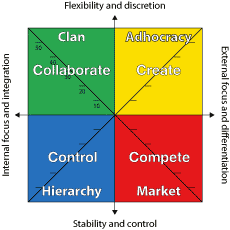
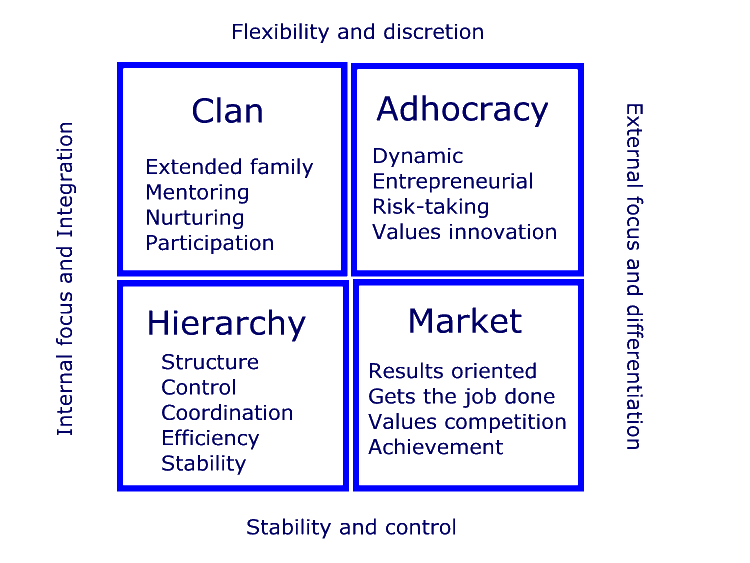
The OCAI assessment divides organizations into four primary structures or groups but most organizations are a mixture of these groups if you do the online questionnaire/assessment you will see the type you prefer or belong to currently.
This assessment is great to understanding where the average employee is and where they want to be. We all have preferences some based on cultural influences some based on professional goals or even experiences, this assessment gives you the insight to help one figure out the best fit for them.
So try it today: https://www.ocai-online.com/
Be careful comparing the results with fellow co-workers who also take the assessment it may lead to heavy debate or heavy eye rolling sessions as you may find out that you have more in common with your co-workers than you possibly want to acknowledge.
Thursday, January 12, 2017
Organizational Clarity as a Blog is A+ material
Good news I started this blog as part of a final project for my Learning Technologies class at Roosevelt University, and when I created the proposal for the project I wanted something with wide berth and something that would amaze my fellow students and the Professor. Great news it worked! I got an A for the class!
I knew I mentioned tech issues, free downloads commentary about issues facing Organizational Development in my proposal so covering it all in one or two posts I knew was impossible. So writing 30 plus posts was a challenge but alas I got my A! and a successful blog.
I will still, will be posting and talking about OD related issues in the near future. I will hopefully have more designs, logo, for free downloading purposes in the near future so happy reading and thanks to all of you who helped make this blog great!
Tuesday, January 10, 2017
Organizational Clarity: "Don’t Fall into the Capability Trap: Does your organization work harder or smarter?" article
During my studies at Roosevelt University, I had the chance to look at their Training and Development blog site, which has a lot of great articles done by Staff, Faculty and Students that are themed along the lines of Organization Development. In this article by (Professor) Kathleen Iverson called: “Don’t Fall into the Capability Trap: Does your organization work harder or smarter?” the author discusses how organizations deal with hard times or competition in a violate market. The article gives some great tips that as a professional you can deliver or repeat to any organizational head and sound like a genius or a “go to” person during times like these.
Give the reader five principles to learn by and follow:
- Don’t expect a quick turnaround
- Metrics are important
- Avoid silos of improvement
- Invest in capabilities, even when times are tough
- Invest in capabilities, even when times are good
Here is the link for the article I am talking about:
It has been my experience in the organizations that I have worked for those organizations usually work harder and they simply ignore these principles discussed in the article. The major of the time organizations lay off employees, experienced employees ruining their overall productivity and their Return on Investment (ROI) in the long run. Following these simple principles would allow any organization to bypass such an action and keep the majority of the seasoned employees while investing in the future during these tough, lean times.
Happy reading!
Monday, December 19, 2016
Ernest Hemingway, a nightmare for the Organization Development Professional or not?
Ernest Hemingway as an icon is profitable for the village of Oak Park, IL however, he had many issues that made him an OD Nightmare. If it was focused upon by a consumer base, it would deter many from holding him in such high regard. So the question from an Organization Development perceptive is could these negatives be turned into positives? If one could turn those negatives to positives would that add to his profitability as a brand?
Could one turn these Hemingway negatives into positives?
- Hemingway’s bouts with depression and the stigma of mental health
- Use of the “N”-word
- Hemingway’s attitude towards women
Hemingway had various bouts of depression which would take a lot more space than I have here to explain about. But let it be known that it is the reason or guiding force behind this Icon’s demise; suicide. From an OD perspective, something as grim as this could be a huge negative when reaching out to younger audiences.
On the flip side, the stigma of mental health issues has gotten better over the years, and treatment for depression has come light years since Hemingway’s death and explaining that as an OD person we have not only turned a negative to a positive we have found a new way for Hemingway to be profitable (Martin, 2006). For example, linking local mental health sand the need for better understanding of depression in the present day, the tragedy of Hemingway’s fight with depression can lead to profitable partnerships with local medical facilities. That would enlighten Hemingway’s gruff exterior or negative image when it comes to depression and cross-section Hemingway to an entirely new audience. Plus, it could allow such organizations like the Hemingway museum to gain more traffic if they are discussing say, new treatments digital cognitive behavioral therapy (dCBT) and how it helps patients today. To the Randomized Controlled Trials, that deals with major depressive episodes either could then be slightly linked to Hemingway as treatments that could have prolonged his life, if introduced at that time. The goal here is given local medical groups an avenue, a partnership to discuss these issues and have another (yet famous) subject to discuss this issue with while drawing attention and revenue to all the organizations involved. These changes as part of the presentation of Hemingway exhibits can reach a newer audience: professionals in the field of psychology, and other related fields.
Hemingway as a womanizer and his overall attitude towards women can, from a clinical psychological standpoint could be traced to his mother. Unfortunately, that could have negative connations as well. Hemingway can be used instead as a lesson of how women’s rights and roles that women play today have evolved. Hemingway’s portrayal of women in his novels, his multiple marriages. and multiple affairs paint the picture of a man that does not hold women in high regard (Assemi, 2012). In this is a foundation to connect how women rights, for being the stay at home mom as the only aspiration for their lives to being able to enter the workforce on an near equal footing as their male counterparts (Cobble, 2005). The Hemingway museum or any other Hemingway-themed organization could add “comparison-discussions” of these changes as part of the presentation of Hemingway exhibits to reach again a newer audience: young women. This new audience would definitely be intrigued by these new discussions (services) offered by these organizations and increasing the organization's customer base.
With Hemingway’s use of the n-word in the short story “The Killers”, Hemingway becomes a polarizing figure much like Mark Twain, from an OD Perspective there is a need to explain the usage of this word was commonplace at the time when Hemingway wrote this story (Hamilton, 2010). It does not make it right, however, it confronts Hemingway’s negative blemish and starts a discussion that Hemingway-themed organizations can partner themselves with civil rights groups, local schools, etc., to introduce why this is not acceptable, in the present day. These discussions would again increase the traffic to Hemingway-themed institutions, by tying Hemingway as a great novelist who is a product of his time, explains this negative blemish that would cripple most organization nowadays. With this type of presentation organizations that romanticize Hemingway can still do so but explain the negative issues of using such language today, without the fear of stigma that would usually go along with it.
In each general approach that I have aforementioned here, is a broad way that an Organization Development specialist can approach a brand that has as many negatives as Ernest Hemingway does, three that are organization killers nowadays. Sexism, Racism and the stigma of mental health would make many shy away from celebrities, brands and organizations, the collateral damage and public relations nightmares that each would cause today could be epic depending on the status of an icon like Hemingway. But with each paragraph is a broad-based approach of how from an Organization Development standpoint one would work to repair that damage wrought by these negatives and bring people back to the brand known as Hemingway.
Assemi, A., Asayesh, M. E., Jabraili, A., Sheikhzade, M., & Hajmohammadian, M. (2012) “Women Ignorance in Short Stories of Hemingway.” 2012 International Conference on Language, Medias and Culture IPEDR vol.33 (2012)
Books Against Time http://www.counter-currents.com/2010/09/race-in-ernest-hemingways-the-killers/
Cobble, D. S. (2005). The other women's movement: Workplace justice and social rights in modern America. Princeton University Press.
Hamilton, Andrew (2010) “Race in Ernest Hemingway’s “The Killers” Counter-Currents Publishing
Luik, A. I., Bostock, S., Chisnall, L., Kyle, S. D., Lidbetter, N., Baldwin, N., & Espie, C. A. (2016). Treating Depression and Anxiety with Digital Cognitive Behavioural Therapy for Insomnia: A Real World NHS Evaluation Using Standardized Outcome Measures. Behavioural and Cognitive Psychotherapy, 1-6. Martin, C. D. (2006). Ernest Hemingway: a psychological autopsy of a suicide. Psychiatry, 69(4), 351-361.
Magnani, M., Sasdelli, A., Bellino, S., Bellomo, A., Carpiniello, B., Politi, P., ... & Berardi, D. (2016). Treating Depression: What Patients want, Findings from a Randomized Controlled Trial in Primary Care. Psychosomatics.
Chipotle, an organization in need of Organizational Change.
With a bunch of E-coli breakouts and sanitary problems at their stores where does the blame lie? With the employees? Store management? Corporate? Obviously, there are standards in place but not being adhered to. The issue has become an even bigger problem for Chipotle and is affecting its bottom line, as per the article (below) customers are staying away in droves.
I know I have seen some disgusting things at various locations like:
- Customers leaning over the sneeze guard pointing at the items they want to workers on the other side
- Workers spit talking into their gloves as they consort with other coworkers and personal visitors.
- I’ve also seen employees wipe the food prep area clean with their gloves/hands and then make the following customer’s (in line) food
I give these examples as reasons why I did not back to any of Chipotle’s locations because they are legitimate instances that maybe at one time we would have:
- Downplayed in some manner (just one time or one bad apple employee)
- Ignored as if we “did not see that” (disbelief)
- Or simply did not catch as loyal customers to our favorite lunch spot.
But with all the bad press Chipotle is receiving you add onto these types of experiences and you wonder does it really matter where the blame lies? Obviously, there is a clear need for an examination of the training and hiring practices that are currently in existence. But from an Organization Development (OD) standpoint, there needs to be an implementation of better coaching practices by the Chipotle management at the local and corporate levels. But what else can be done?
One possibility is that there be a lack of mystery shoppers for the organization, something we never hear Chipotle publicly admitting as other fast food chains do. This could be the leading factor to why there is missing data of these issues or why this problem “blew up” into this major catastrophe as it did. This data would have clearly given Chipotle a clear point of view regarding the chain’s hygiene and other assorted practices from the customers at a ground level.
Maybe the issue lies within the typical corporate culture that many organizations are guilty of and Chipotle is simply ignoring or whitewashing the truth about its stores for its investors and the generic public. In either case, how does Chipotle right its ship and gain its faltering customer base back? Free burritos? Chorizo? Maybe the organization needs to do something more drastic either way it would be an incredible challenge for the average OD professional but where would you start?
You can read more about Chipotle’s issues by clicking on this hyperlink:
Free E-book: Mobile Learning 101 - All About Mobile Learning Design and Development
I usually get emails from CommLab India site to increase my knowledge of E-Learning to gain some free tips and free resources on how to implement E-Learning in the workplace or how to easily find cheap solutions to organizational needs. In one email, I received, I saw a link to this E-book: “Mobile Learning 101 - All About Mobile Learning Design and Development” it is another short guide that will give a general breakdown of what mobile learning is and how to explain its uses and positives to clients who have thought about introducing it into their Organization’s training methodology. This free E-book states by the end of reading it you should be able to:
- Explain What is Mobile Learning?
- Know what Factors Influencing M-learning
- Be able to create Learning Design Strategies for your organization for Mobile devices
- Be able to explain: How Does M-learning Fit with Other Training Initiatives
- Be able to explain: How Mobile Learning Can Support Different Trainings
- Be able to give Examples of Organizations Using Mobile Learning
It is Free and in PDF Format plus it is a great resource that assists your organization in your quest to integrate M-Learning (Mobile Learning) as an option for training in your organization. Just click on the link here: http://bit.ly/2hnZuNf
Free E-book: E-learning: Getting your Organization READY
As I mentioned before, I signed up for emails from the CommLab India site to increase my knowledge of E-Learning to gain some free tips and free resources on how to implement E-Learning in the workplace or how to easily find cheap solutions to organizational needs. Well, in one email I saw a link to this E-book: “E-learning: Getting your Organization READY” it is a short guide that will help you and your organization “implement and embrace eLearning” while also assisting in Organizational change of the culture to adapt to E-Learning as an official training methodology. This free E-book states by the end of reading it you should be able to:
- “Evaluate your organization’s readiness for eLearning
- Build a compelling business case for the top management
- Decide on whether to make or buy eLearning
- Choose an eLearning partner
- Overcome barriers of implementation you may face along the way
- Implement eLearning successfully in your organization”
It is in PDF Format and did I say free? Yes, free, meaning that it is a great resource that assists your organization in changing its culture so that you can adopt and implement E-Learning as an effective training method in the workplace. Just click on the link here: http://bit.ly/2dXNbUB
Sunday, December 18, 2016
Free E-Book: "Authoring Tools That Address Your 5 Biggest Training Challenges"
I recently signed up for emails from the CommLab India site to increase my knowledge of E-Learning to gain some free tips and free resources on how to implement E-Learning in the workplace or how to easily find cheap solutions to organizational needs. Well, in one email I saw a link to this E-book: “Authoring Tools That Address Your 5 Biggest Training Challenges” it lists five challenges that face trainers and authoring tools that can solve them. The five Challenges this free E-book covers are:
- Rapid Conversions
- Interactive E-learning
- Quick Translations
- Responsive E-learning
- Ease of Online Review
It is in PDF Format and did I say free? Yes, free, meaning that it is a great resource that defines the challenges that may face your organization and tells you the E-Learning authoring tools you can use, without you or your organization wasting time and money researching various programs. Just click on the link here: http://bit.ly/2hhfccz
Finding Organizational Development organizations to network with, follow or even learn from.
When it comes to Organizational Development there are certain groups you can follow on popular social media sites either Twitter, Blogger, Google Plus, or Facebook, each of these Organizations, allow you access to articles, special tips for Organizational Development (OD) and offer (paid) goods or services that can help you with issues you or your organization may face. Plus, these sites are great for networking, publishing articles for blogs upon, and grow your OD brand overall. One of the main things OP Professionals must do constantly is network and investigate new ideas and solutions to beat the 70% probability of failure when change is implemented in the organization.
One of the main organizations I use a lot is OCAI, Marcella Bremer, who has produced a lot of articles that discusses the failures within Organizational Change and how management’s positive impact can make change possible and change the organization’s culture. The Organization Development Network is more of a paid site however one of the reasons I choose this organizational is because of the annual workshops, the 2017 OD Network Annual Conference happens in October right in Chicago, IL giving the OD Professionals not only a membership in a collective but a major chance to network with other like-minded professionals. But also as a member you will have the chance to work with the organization with Coaching and Mentoring programs to finding a job in the field being a member can have its advantages (and opportunities)! The last one, the Centre for Organization Development you will have the chance to train with the organization at different programs as a member, but on an international stage.
In case you want the chance to connect or just check out more about these organizations that focus on Organizational Development, down below is their primary website, social media sites
OCAI, Marcella Bremer: OCAI.com you can follow this organization on these popular social media sites, Twitter, Google Plus community and Facebook at:
- https://plus.google.com/u/0/communities/104244751799086975666
- https://twitter.com/MarcellaBremer
- https://www.facebook.com/marcella.bremer.1
Organization Development Network: http://www.odnetwork.org/ you can follow this organization on these popular social media sites, on Twitter and Facebook:
- https://twitter.com/ODNetwork
- https://www.facebook.com/ODNetwork/
Centre for Organization Development: http://www.codhyd.org/ you can follow this organization on these popular social media sites, Twitter, Blogger and Facebook at:
- https://twitter.com/codhyd
- https://www.facebook.com/Centre-for-Organization-Development-146834348697514/ http://codhyd.blogspot.com/
Happy Networking!
A favorite in my playlist called Organizational Development?
Easy question to answer, I think this is a really fun video and straight to the point, discussing “What is Organizational Change?” from Mavim B.V. I love the engaging interaction, smooth animation, and great quick delivery. I believe in trying to get management and employees in a resistant organization, you need to have small baby steps to gain these groups’ trust and cooperation.
This video easily puts into perspective the fact that change is constant, and that change is needed for a business to remain competitive. Add with that the advent of social media customers have a larger voice than ever before so communicating with them has changed and an organization must be able to change to communicate with those customers properly.
You can find all of this information in the video, “What is Organizational Change?” just click on the hyperlink below:
https://www.youtube.com/watch?v=5xsPLr-q_Nk&index=7&list=PLl128ljkxUxp5-MqyB_uGXEDCK4cVwGKw
Saturday, December 17, 2016
5 Things You Should Know About E-learning
I recently read an article called “5 Things You Should Know About E-learning” by Sravanthi Reddy G, the author makes a five-point presentation, about the basics of E-Learning, but I look at it as five ways to overcome resistance to adding E-Learning to your organization’s training repertoire.
From arguing that it has been around for a long time to easy ROI measurability when it is used for training purposes, these are five brief reasons that you can add on to an argument to increase E-learning in your organization or finally get the go ahead to introducing it. I have seen the difference that an E-learning presence can make in an organization, I have worked at organizations that have it and do not and the differences are literally night and day.
The Main excuse for resistance is not about money although it is a factor, it is just knowledge about E-learning is limited due to fear of technology and belief that it is a fad. Two resistance points that are easily denounced with reason #2 and #5 but points that readily come up time and time again, if you see the same thing happening in your organization I urge you to click on the hyperlink below and read the article about E-Learning to educate yourself and your organization’s E-Learning dissenters
Here is the hyperlink to “5 Things You Should Know About E-learning” by Sravanthi Reddy G:
http://blog.commlabindia.com/elearning-design/5-things-to-know-about-elearning
Subscribe to:
Posts (Atom)